
Best AI Website Builder: The Ultimate Guide for eCommerce Sellers and Amazon FBA Entrepreneurs
Tuesday, April 7, 2026
The best AI website builder has become a game-changing tool for entrepreneurs, especially for eCommerce sellers and Amazon FBA businesses seeking efficient, visually engaging, and data-optimized websites. By automating design, content creation, and page optimization, these builders save countless hours while improving user experience and scalability.
For entrepreneurs competing with major retailers, choosing the right AI website builder is not just a convenience—it’s a path toward sustainable growth, customer engagement, and brand consistency. Understanding how to implement and make the most of these technologies ensures that your online presence is powerful, conversion-focused, and future-ready.
1. Understanding what an AI website builder is
An AI website builder uses machine learning and natural language processing to automatically create websites based on a user’s inputs, preferences, and goals. It eliminates the need for coding knowledge, crafting responsive layouts, generating on-brand content, and integrating essential eCommerce modules. For online sellers, this means transforming complex design processes into guided, simplified workflows.
AI builders work intelligently by analyzing design trends, performance data, and audience intent. For instance, if you describe your business as an eco-friendly Amazon FBA seller, the AI may choose nature-inspired color palettes, minimalist typography, and product descriptions aligned with sustainability values. The system isn’t just assembling elements—it’s learning what will resonate with users and what layout patterns statistically convert better.
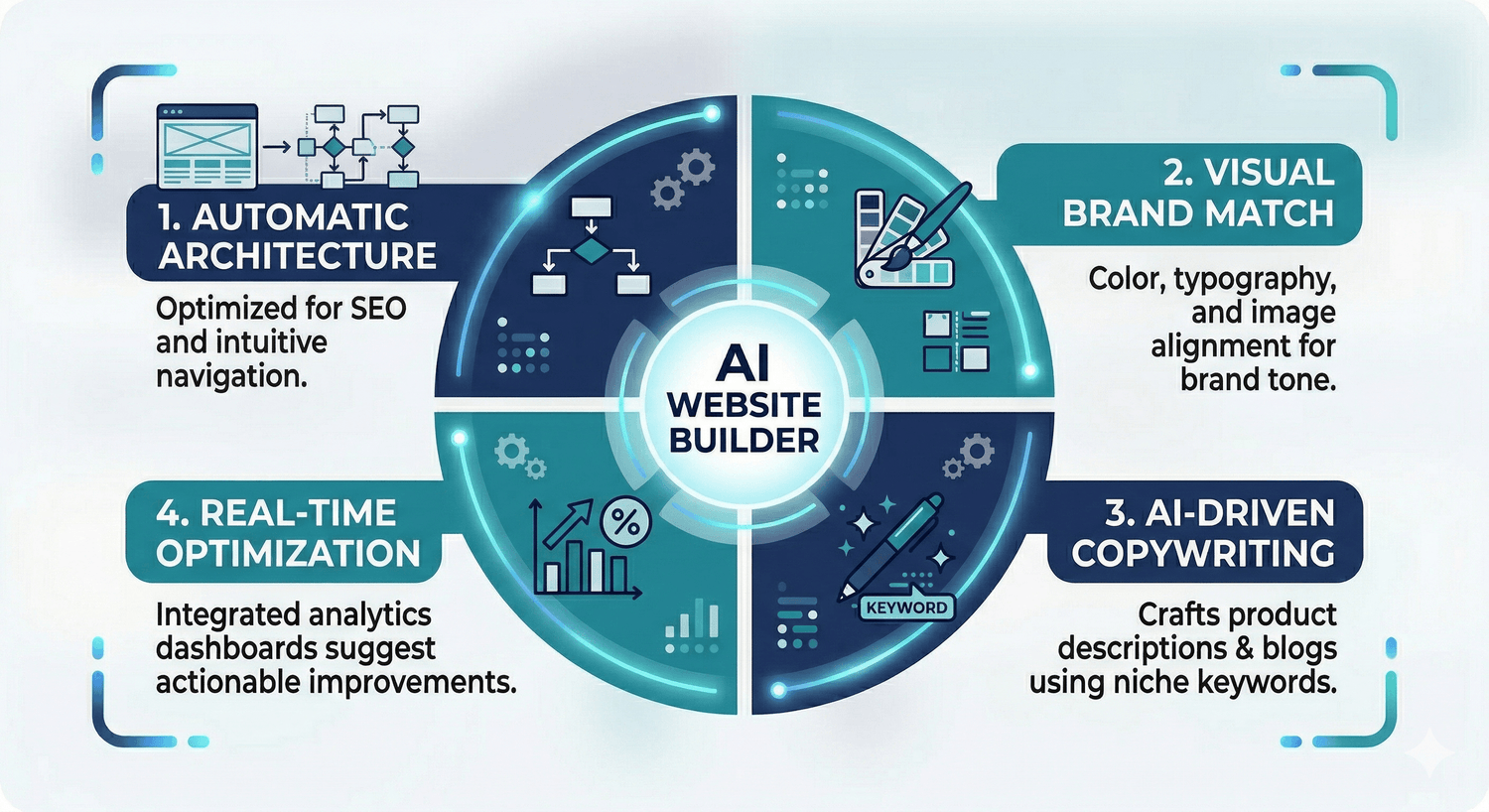
How AI builds websites smarter
- Automatically generates site architecture optimized for SEO and logical navigation flow.
- Chooses color schemes, typography, and image alignment to match your brand tone.
- Drafts product descriptions and blogs using AI-driven copywriting tuned to your niche keywords.
- Integrates real-time analytics dashboards to track engagement and suggest optimizations.
By employing the best AI website builder, entrepreneurs spend less time coding and more time amplifying business strategy—like refining product sourcing, testing ad creatives, or building email funnels that convert.
2. Why eCommerce sellers need the best AI website builder
In the hypercompetitive eCommerce environment, customers make split-second decisions based on visual appeal, performance, and trust. A professional, fast, and consistent website can boost perceived brand value as much as the product itself. Amazon FBA entrepreneurs often focus on product listings within marketplaces—yet owning a standalone site built with AI gives you diversified traffic sources and brand control. The best AI website builder equalizes the playing field by providing enterprise-level design capabilities for small and mid-sized sellers.
Key benefits
1. Speed of launch – Launch a store in hours instead of waiting weeks for developers.
2. Optimization – Automated data-driven tweaks ensure layouts support conversion goals.
3. Scalability – Add new categories, product bundles, or pages as inventory expands.
4. Cost efficiency – One subscription replaces numerous freelancer tasks and maintenance costs.
5. Consistency – Uniform branding and copy style across every product and landing page.
In real-world examples, sellers who switched to AI-assisted builders have reported 30% faster go-to-market cycles and measurable improvements in engagement metrics. According to Forbes, businesses embracing automation tools experience conversion boosts of up to 25 percent due to faster page loading, tailored recommendations, and improved design flow.
3. Features to look for in the best AI website builder
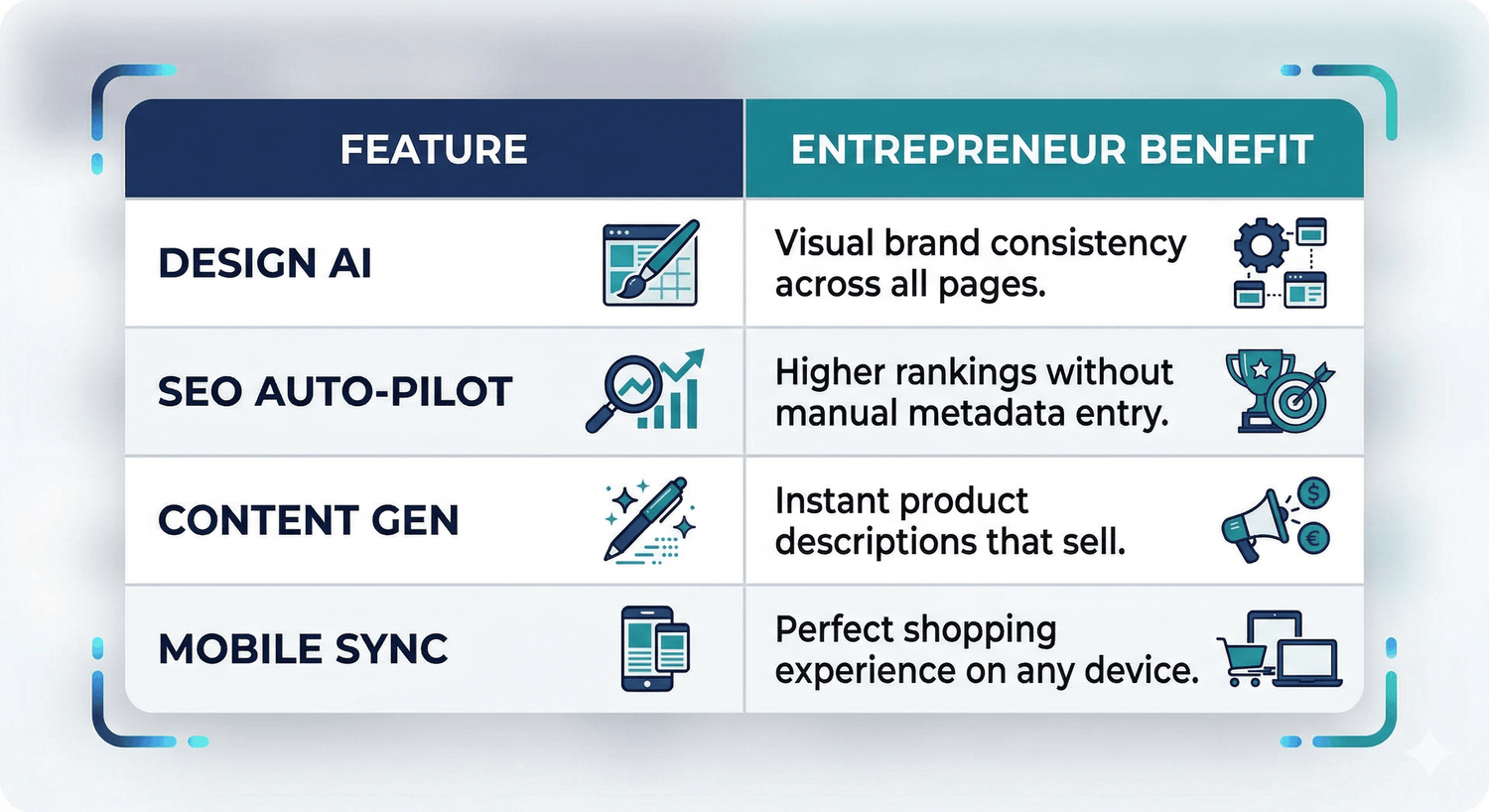
When selecting your platform, pay attention to functionality depth and integration potential. The most valuable builders don’t just make your site look good—they connect intelligence, marketing automation, and scalability. Below is a quick comparison to guide decision-making:
Feature
AI-driven design suggestions
SEO automation
Content generation tools
Integrations
Mobile responsiveness
AI analytics reports
Benefit
Ensures cohesion between product positioning and user interface elements
Auto-updates metadata, headings, and URL structures for search visibility
Crafts descriptions, blog outlines, and category copy using keyword data
Connects to eCommerce, payment, and analytics ecosystems easily
Provides superior mobile experiences that minimize bounce rates
Advises which pages, campaigns, or product clusters need adjustments
For instance, suppose you’re optimizing a “Best Seller” page. A top-tier builder may recommend product placement that prioritizes items with high review volume and cross-sell potential. These small AI-led improvements compound into higher sales velocity.
4. Evaluating performance: speed, SEO, and usability
Performance affects first impressions and rankings. Modern AI builders use cloud hosting and real-time code optimization to ensure quick load speeds. Google’s own studies indicate that even a one-second delay can reduce conversions by up to 7%. Thus, evaluating your builder through measurable criteria is key.
Tips to test builder performance
- Use free speed audit tools such as GTmetrix or PageSpeed Insights to identify slow assets.
- Ensure feature support for schema markup—critical for appearing in rich search results.
- Review usability on various devices, including tablets, as many buyers now purchase via mobile.
- Track user journey maps using analytics integrations to identify abandoned steps.
AI systems learn from behavioral feedback, refining your layout based on user flow and device type, keeping your store consistently efficient.
5. Comparing top contenders
Different providers excel in different areas. Some prioritize creative flexibility, while others lead in AI-backed SEO automation. Here is a comparative snapshot:
Platform
Builder A
Builder B
Builder C
Best for
Small eCommerce startups
Amazon FBA sellers
Scaling brands
Key strength
Drag-and-drop simplicity plus AI branding quiz setup
Syncs product data directly and automates listing optimization
Advanced personalization and dynamic landing pages
Anecdotally, Builder B’s automation has been praised by Amazon resellers who manage hundreds of SKUs. According to Statista, since 2021, AI adoption across digital retail has doubled, proving that early adopters retain better margins and adapt faster to market shifts.
6. Integrating AI website builders with eCommerce tools
Modern eCommerce operations involve multiple touchpoints: logistics, CRM, payment systems, and social media marketing. The best AI website builder unifies these so your workflow remains seamless. Imagine your AI builder automatically pulling your Amazon stock data, adjusting web inventory counts, and sending automated restock alerts—that’s integration at work.
Common integrations
1. Amazon sync enabling FBA listing mirroring and unified inventory counts.
2. Email software linking automated personalized post-purchase campaigns.
3. Social APIs creating instant promotional pages from trending products.
4. CRM and loyalty systems syncing to segment users and retarget intelligently.
This automation loop means fewer manual updates, reduced human error, and optimized lifetime customer engagement. Combined with analytics dashboards, integrations provide clear insights into profitability and repeat-purchase behavior.
7. Common mistakes and how to avoid them
Even with sophisticated tools, human oversight is vital. Missteps can reduce effectiveness and increase costs if left unchecked. Below are common mistakes and preventive solutions:
- Ignoring AI feedback: Builders often recommend SEO or layout fixes—implement these regularly.
- Disorganized product data: Use clean CSV imports with clear tags and variant structures.
- Underestimating human editing: Always review AI-generated text for tone and accuracy.
- Keyword stuffing: Search engines reward authenticity—prioritize readability.
Smart eCommerce sellers blend machine efficiency with human creativity. A well-tuned AI builder amplifies rather than replaces strategic insight.
8. Cost versus value
Pricing across platforms can range from free tiers with limitations to enterprise packages supporting multimillion-dollar stores. Evaluating costs means tracking return on time saved, development overhead minimized, and performance gained. For example, if building your site manually would require a $5,000 developer fee and three weeks of work, an AI builder subscription of $30–$100 per month delivers immediate ROI.
Most vendors offer flexible monthly and annual plans with strategic upgrades—often including built-in hosting, SSL, and support. When choosing, calculate _value per output_: if the builder brings faster traffic growth or higher checkout completion, even premium pricing becomes cost-effective.
9. Future trends in AI website creation
AI web design continues advancing toward conversational commands, predictive design, and hyper-personalization. Soon, business owners will simply describe a product line or campaign intent, and the builder will create optimized subpages with matching visuals and calls-to-action.
Emerging innovations
- Voice-guided design tools: Websites editable through spoken commands or chat interfaces.
- Generative AI storytelling: Tailors brand narratives unique to each target customer.
- AI-driven UX testing: Constantly measures visitors’ micro-interactions to refine elements in real time.
- Cross-platform consistency: Synchronizes visual cues between your site, ads, and marketplaces.
Keeping your eye on upcoming updates ensures you remain aligned with design standards and technology shifts. Industry pioneers predict that by 2026, over half of all small business websites will include generative AI design systems embedded directly into their content management structures.
10. When to hire a professional
While AI builders cover most functional requirements, sometimes your brand demands custom code, interactive animations, or complex backend integration. That’s when partnering with experts comes into play. Agencies experienced in AI-enhanced design can extend your builder’s functionality through API connections, bespoke themes, and advanced conversion funnels.
If you’re considering such a partnership, Fuel Your Digital offers tailored support combining human creativity with automated intelligence. This hybrid approach delivers seamless design flow, integrated analytics, and strategic optimization for scaling eCommerce businesses.
Frequently asked questions
1. What makes an AI website builder different from traditional platforms?
AI builders automate major tasks—layout selection, color coordination, and SEO markup—whereas traditional platforms rely on manual configuration. This saves enormous setup time and reduces the margin for error.
2. Can the best AI website builder handle complex eCommerce stores?
Absolutely. Most leading tools manage thousands of SKUs, integrate with global payment processors, and automate category updates without data corruption risk. They scale parallel with your business size.
3. How secure are AI-built websites?
These builders follow top security protocols, often including SSL by default, encrypted databases, and constant security monitoring. Look for AI builders offering DDoS protection and GDPR compliance where applicable.
4. Will my site still need manual updates?
Yes. AI handles optimization and automation layers, but humans must refresh content for seasonality, branding evolution, and customer response. The blend of automation and active management ensures relevance.
5. How does using the best AI website builder impact SEO rankings?
By optimizing metadata, site speed, and structured data automatically, AI builders give immediate SEO improvements. However, link-building, fresh content, and audience engagement still drive long-term ranking dominance.
Author info
Author: Lucija Petric
_Content Strategist & eCommerce SEO Specialist_ Lucija Petric writes extensively about AI-driven marketing, digital optimization, and innovative automation for retail brands.
Share this article
Free for Amazon Sellers
Get the FREE 4-Step Amazon Growth Strategy
The exact framework used by 4,000+ Amazon brands to launch, optimize, and scale — yours free.