intelliRANK Blog

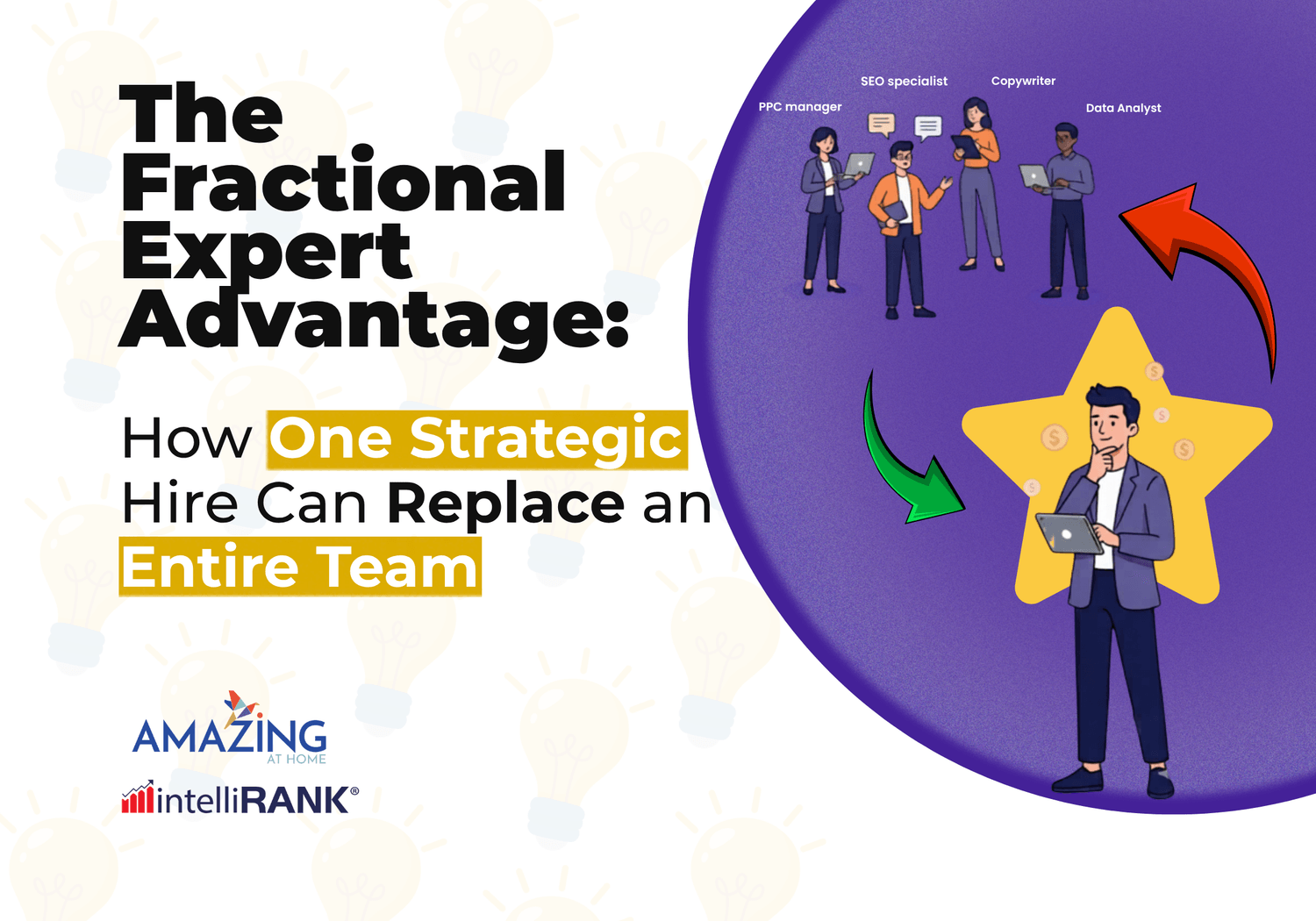
The Fractional Expert Advantage: How One Strategic Hire Can Replace an Entire Team

SHARE


Get the FREE 4-step Strategy Plan eBook

that will help you Increase your Amazon Sales immediately...

By Amy Wees, CEO of Amazing at Home

If you are running an eCommerce brand right now, a fractional expert might be the single most underused resource available to you. Most brands are not stuck because they lack ambition. You are stuck because you are trying to do everything with too few people, too little time, and no clear answer to one question: what do you focus on first that will actually move the needle?

I see it constantly. You have a dozen tabs open in your head at all times. The listing needs new images. PPC is bleeding money on the wrong SKUs. The website has not been touched in two years. A new product is sitting in a folder waiting for prototyping. The supplier just raised prices again. You know each of those things matters. What you do not know is which one to fix first, how to fix it efficiently, or who on your lean team has the bandwidth and the skill to actually get it done.

That is where a fractional expert changes the math entirely.

What a fractional expert actually does

A fractional expert is not an agency, is not a coach who only talks, and is not a contractor who waits for instructions. A fractional expert is someone with senior-level experience across multiple disciplines who plugs into your business, diagnoses what is actually going on, decides what to prioritize, and then either executes the work directly or directs your existing team to execute it the right way.

For most six and seven figure brands, this is the missing piece. You do not need a full-time COO at 180k a year. You do not need three different agencies each touching one slice of your business. You need one person who has done this enough times to know exactly which lever to pull, in what order, and why.

I can do this kind of work for brands because I have spent nearly 15 years selling on Amazon and eBay, built and exited my own seven-figure brand, run sourcing trips through China, Mexico, and Jordan, filed patents on my own inventions, and consulted with hundreds of brands across categories from supplements to toys to home goods to consumer electronics. The patterns repeat. The fixes are usually the same five to ten things, in a specific order. Most brand owners have just never had someone walk in and name them.

Here is what that actually looks like in practice, through four recent engagements. The names and categories have been changed, but the work is real.

Case study one: a home goods brand bleeding money on the wrong SKU

A home goods brand selling kitchen organization products came to me with a problem you would probably recognize. Sales were declining year over year, ad spend was climbing, and profit was disappearing. They had a strong product line and decent reviews. The numbers just were not working.

When I dug into the data, the issue jumped out fast. Their PPC spend was wildly imbalanced across SKUs. The top performer was being starved of budget while a weaker variant ate daily spend with poor conversion. Underneath that was a deeper issue. The imagery was not communicating the premium positioning their price required, and they had aging inventory sitting with no liquidation plan.

I built them a thirty-day profitability roadmap. Phase one was an immediate PPC rebalance with specific terms to negate, specific terms to harvest into exact match profit campaigns, and a weekly operating ruleset their team could run on Mondays without me. Phase two was an image gallery rework using a seven-image conversion strategy that ties features to outcomes and justifies the premium price. Phase three was a controlled price test paired with a promotion structure to liquidate dead inventory through their high-traffic listings, no extra ad spend required.

Their team did not have to learn PPC, conversion psychology, image strategy, and inventory management all at once. A fractional expert brought all of it in one engagement, and their internal team got upskilled in the process. That is what the fractional model looks like when it works.

Case study two: a toy brand whose listings had not kept up with their category

A toy brand on Amazon reached out because sales had flattened and they could not figure out why. They had a solid product, but something was not landing with buyers anymore.

When I looked at their listings, the gaps were obvious. Their imagery was not telling the right story, their copy was not speaking to what parents in that category actually care about, and their brand presentation looked dated next to what the category had evolved into. The product itself was fine. The way it was being presented had not kept up.

This engagement looked completely different from the home goods one. I walked them through everything that was missing from their listings, recorded a Loom showing exactly what needed to change and why, and laid out a full rebrand so they could stay relevant in a category that had moved without them. From there I built them a roadmap of what to tackle next: new image hierarchy, refreshed A+ content, updated brand positioning, and a sequence for rolling out the changes without disrupting their existing sales.

This is the part most brand owners miss. The work I did for the toy brand had almost nothing in common with the work I did for the home goods brand. Different problem, different diagnosis, different fix. But a fractional expert can do both, because enough years across enough categories creates pattern recognition you cannot get any other way.

Case study three: a wellness brand stuck in prototyping limbo

A wellness brand had a great product concept but had been stuck in development for over a year. Samples did not match the vision, costs were higher than projected, and they were starting to wonder if the whole thing was a bad idea.

I came in as a fractional product development partner. In the first week we redesigned the spec to remove three components that were driving most of the cost and adding nothing customers cared about. I introduced them to two vetted suppliers from my sourcing network, helped them run a side by side sample comparison, and walked them through a small prototyping run that got them to a final spec in about six weeks.

From there we built the launch listing, the brand positioning, and a manufacturing schedule that aligned with their cash flow. The total fractional investment was a fraction of what they had already spent on a year of failed sampling, and at the end of it, they actually had a product they could launch.

If you are sitting on a product idea that has been stalled for months, this is exactly the kind of logjam a fractional expert is built to break. One set of experienced eyes on your spec, your supplier conversations, and your manufacturing plan can save you a year of wasted cycles.

Case study four: a consumer brand whose website was embarrassing them

A consumer products brand selling on Amazon and direct to consumer came to me because their direct sales were almost nonexistent. They had a Shopify site that looked like it was built in 2018, no clear messaging, no email capture strategy, and no way to convert the traffic that was actually showing up.

This is where the fractional model gets really interesting. I do not personally code websites, but I have a full-time web designer and a graphic designer on my team. So my engagement here meant I audited the site, wrote the new messaging and page structure, directed my designers to execute the rebuild, and made the strategic calls on layout, conversion paths, and brand voice.

The brand got a complete website overhaul, professional creative, new product photography direction, and a launch-ready email capture flow without having to hire a designer, an art director, a copywriter, and a brand strategist separately. They got all of it through one relationship.

That is the leverage of hiring a fractional expert. You are not just buying hours. You are buying access to a team that has already been vetted and built into systems that work.

The common thread: one brain, many departments

When you look at those four engagements, the disciplines covered include PPC optimization, listing conversion, image strategy, inventory management, product positioning, product development, sourcing, supplier vetting, prototyping, website design direction, brand creative, copywriting, and email capture strategy. That is at minimum six different specialists if you tried to hire it all out. Probably more.

The reason a fractional expert can replace that kind of team is experience compression. After enough years doing this work across enough brands, you stop seeing problems as siloed. You start seeing them as connected. The PPC issue is almost always a listing issue is almost always a positioning issue is almost always a product issue. When one person can hold all of it in their head at once, the fixes get faster, cheaper, and more effective.

That is also why a fractional expert usually beats agencies for brands at this stage. Agencies are organized around their service. A PPC agency sees a PPC problem. A creative agency sees a creative problem. A fractional expert sees the actual problem and then decides which lever solves it.

Who the fractional model is built for

A fractional expert is the right fit if any of this sounds like your business right now.

  1. 1. You know something is off with your numbers, but you cannot tell if the fix is a listing issue, an ad issue, a pricing issue, or a positioning issue.

  2. 2. You have a small team that is working hard but spinning on the wrong things.

  3. 3. You have been in development on a product for too long and need someone to break the logjam.

  4. 4. Your website or creative is holding back your direct sales, but you cannot justify hiring a full creative team.

  5. 5. You have outgrown DIY, but you are not ready for a full agency relationship that costs more than the problem you are trying to solve.

If any of those land, the question is not whether you need help. The question is whether you can find one person who has done enough of this work to actually know which thing to fix first.

How to get started

If you are sitting on a project that has been stuck for too long, or you know there is profit hiding in your business but cannot figure out where, head over to amazingathome.com and fill out the Ask Amy form right on the home page. Tell me what you are working on and where you are stuck. I will take a look and let you know what I see and how I can help you move forward.

The cost of staying stuck for another six months is almost always higher than the cost of bringing in the right person for a focused engagement. A fractional expert is not an expense. It is the fastest way to stop guessing and start executing on the things that will actually grow your brand.


About Amy Wees

Amy Wees is the CEO of Amazing at Home eCommerce Consulting and a successful entrepreneur who built and sold a seven-figure eCommerce brand.

Amy is an AI thought leader, patent holder, and combines 18 years of military experience in strategic planning with proven eCommerce expertise across product development, sourcing, listing optimization, PPC, and brand building. Amy has helped thousands of brands launch successful private label products using the same strategies that led to her own profitable exit. Learn more at amazingathome.com.

FOLLOW US ON SOCIAL MEDIA
JOIN OUR BUSINESS EDUCATIONAL NEWSLETTER

© Copyright 2025 - intelliRANK.info - All rights reserved. Terms of Service. Cookie Declaration.